Scale, Nature, and People
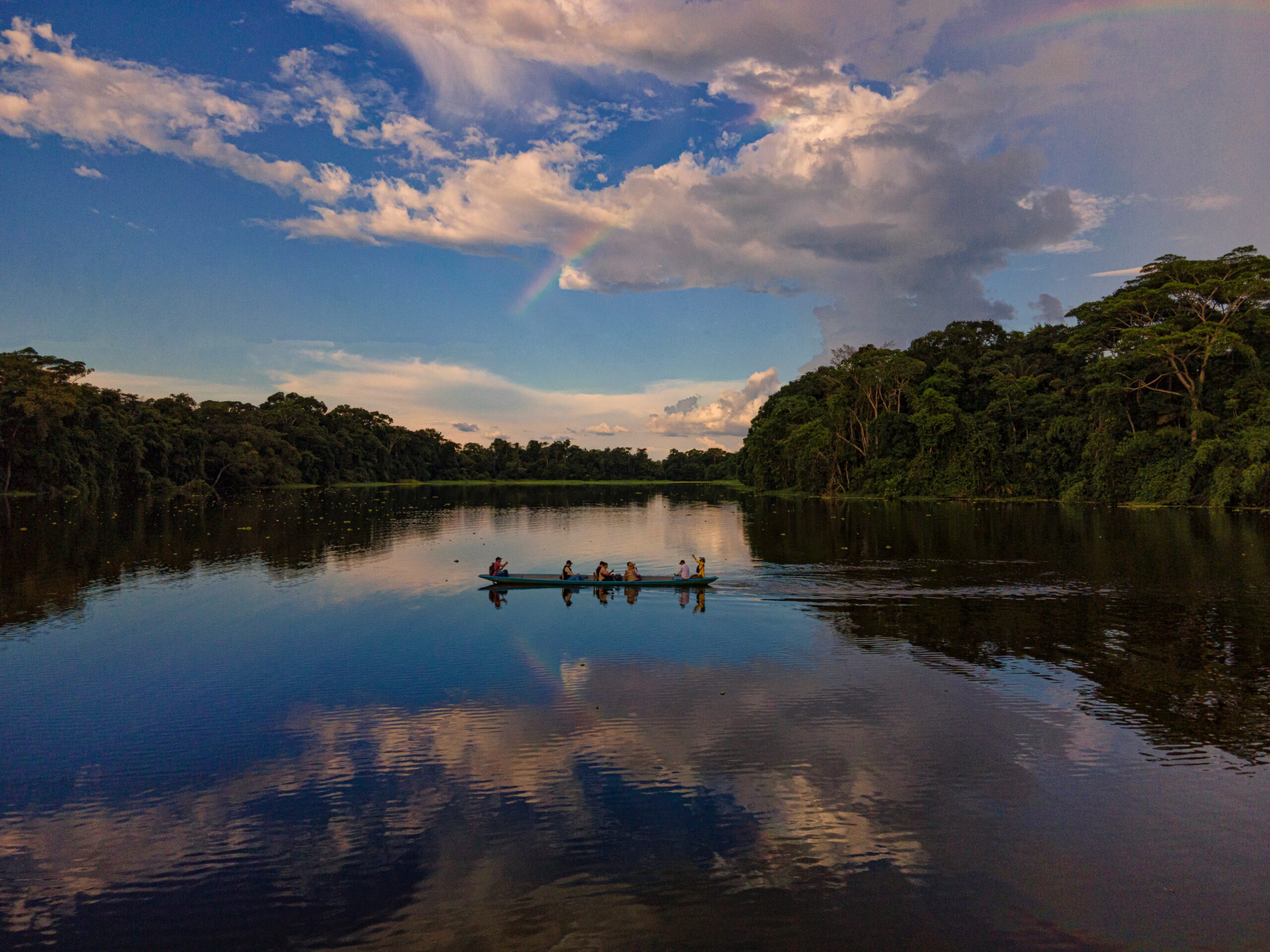
The Amazon defies easy description. This rainforest stretches across nine countries, covering 6.7 million square kilometres and sheltering one in every ten species known to science. Flying into Manaus, the capital of the Brazilian Amazon, offers your first glimpse of its true scale. Green canopies extend endlessly in every direction, broken only by the meandering ribbon of the river itself. This isn’t simply a river but rather an inland sea, with tributaries that dwarf Europe’s Danube or North America’s Mississippi.
Often called the lungs of the Earth, the Amazon regulates not only South America’s climate but influences rainfall patterns as distant as California and West Africa. Brazil holds approximately 60% of the forest, Peru around 13%, and Colombia 10%. The remainder belongs to Bolivia, Venezuela, Ecuador, Guyana, Suriname, and French Guiana (an overseas department of France). For most travellers seeking Amazon travel experiences, however, Brazil and Peru remain the natural gateways.
Visiting the Amazon means encountering nature at its most spectacular: pink river dolphins surfacing beside wooden canoes, scarlet macaws painting the dawn sky, and waters so vast you cannot see the opposite bank. The Amazon River begins high in the Peruvian Andes, where snowmelt trickles down to form the Ucayali and Marañón rivers. By the time it reaches Brazil, it has swollen into a giant flowing eastward for 6,400 kilometres (4,000 miles) before meeting the Atlantic at Belém. During the wet season, at its widest point, the river stretches to 40 kilometres (25 miles) across.

The ecosystem it nourishes is unparalleled. Over 16,000 tree species, more than 430 mammal species, and over 1,300 bird species inhabit the basin. Jaguars prowl the riverbanks while giant otters fish in oxbow lakes, and armies of leafcutter ants carve highways through the undergrowth. Seasonal flooding transforms vast areas into a watery labyrinth where wooden stilt villages rise from the waters and canoes replace roads. This rhythm of high water from December to May and low water from June to November shapes every Amazon travel experience. High water means easier canoe access to flooded forests, while low water reveals sandy river beaches and concentrates wildlife along shrinking channels.
The Amazon is also home to some 30 million people, including around 400 indigenous groups whose forest knowledge remains unmatched. Communities such as the Tikuna in Brazil or the Shipibo-Conibo in Peru have lived with the river’s rhythms for centuries, using plants for medicine, fish for sustenance, and forest clearings for small-scale agriculture. Today, many face the challenge of preserving their traditions amid pressures from deforestation, mining, and migration. Visitors who stay in community-run lodges or join guided visits often gain deep appreciation for how survival here has always depended on balance: taking only what the forest can give, and giving back in return.
For travellers, access begins in the cities straddling the forest’s edge. Manaus, the capital of Amazonas state, sits just four hours by air from Rio or São Paulo. Once a rubber-boom city, its ornate opera house recalls that gilded age. Nearby, the Meeting of the Waters presents an unmissable natural spectacle where the dark Rio Negro and sandy-coloured Amazon run side by side for several kilometres without mixing. From Manaus, travellers venture to jungle lodges or embark on river cruises.
Belém, at the Amazon’s mouth, blends rainforest culture with Atlantic history. Its markets overflow with tropical fruits and Amazonian spices. Across the border in Peru, Iquitos thrives in splendid isolation, reachable only by boat or plane. It serves as the departure point for river cruises penetrating deep into Pacaya-Samiria National Reserve. Puerto Maldonado, more easily reached from Cusco, opens the gateway to Tambopata National Reserve, famous for its clay licks where hundreds of macaws gather in riotous colour.
Each entry point offers distinct flavours: Manaus represents urban-meets-forest, Belém embodies coastal-Amazonian culture, Iquitos promises remote immersion, and Puerto Maldonado delivers accessible yet wildlife-rich experiences.
Sample Itineraries

Many travellers dream of Brazil: Rio de Janeiro’s beaches, Salvador’s Afro-Brazilian rhythms, the thunder of Iguazu Falls. Adding Amazon travel might seem daunting, but it fits seamlessly into a two or three-week journey. The key lies in viewing it not as a separate expedition, but as a vital layer in a wider Brazilian adventure.
Two Weeks in Brazil (14 days): Begin with Rio de Janeiro, where four days allows time for both the icons (Sugarloaf, Christ the Redeemer, Copacabana) and subtler neighbourhood charms of local cafés and Ipanema sunsets. From Rio, fly south to Iguazu Falls for three days. Standing on the catwalk above Devil’s Throat as millions of litres thunder past each second ranks among South America’s great spectacles.
Turn north to Manaus for four days of Amazon travel. A lodge stay or river cruise offers canoe trips through flooded forest, nocturnal caiman spotting, and mornings awakening to howler monkey calls. Conclude in Salvador for three days of music-filled squares, Bahian cuisine, and Afro-Brazilian culture—a finale of rhythm and warmth.
Three Weeks in Brazil (21 days): Additional time opens possibilities for deeper Amazon immersion. Spend four days in Rio and four at Iguazu as before, then dedicate five full days to the rainforest. The extra time permits travel further upriver, stays in more remote lodges, and night safaris or multi-day canoe expeditions. Afterward, four days in Salvador allows a more leisurely pace for wandering Pelourinho’s colonial streets or relaxing on nearby beaches.
The final chapter could feature four days in the Pantanal, where jaguars and giant anteaters roam open floodplains, or in São Paulo, whose galleries and gastronomy reveal a cosmopolitan Brazil often missed by visitors.
Brazil + Peru Combination: Another option combines two countries for richer contrast. Begin in Rio for four days, then Iguazu for three. From there, fly to Peru’s Iquitos or Puerto Maldonado for four or five days of Amazon travel. In Iquitos, river cruises enter Pacaya-Samiria National Reserve, while Puerto Maldonado provides access to Tambopata’s clay licks and wildlife-filled oxbow lakes.
The contrast is striking: Brazil offers vast-scale Amazon experiences with urban entry points and longer river journeys, while Peru provides more compact, wildlife-rich stays perfect for shorter timeframes.
Conclude with Cusco and Machu Picchu, where Andean peaks and Inca history offer striking counterpoint to the rainforest. This itinerary balances coast, forest, and highlands—three South American worlds in one journey.
Whichever route you choose, the message remains clear: the Amazon isn’t a distant wilderness requiring isolated expedition, but rather a three to five-day addition that elevates any Brazil trip from memorable to extraordinary.
Fragility and the Future

No Amazon journey concludes without acknowledging the region’s fragility. Recent decades have seen accelerated deforestation from cattle ranching, soybean farming, logging, and illegal mining. Deliberately set fires scar the canopy to clear land. Climate change adds another stress layer. Brazil’s policies have swung with political winds, from protection under one administration to loosened enforcement under another. Peru faces similar challenges, particularly with illegal gold mining in Madre de Dios. Yet progress continues: new protected areas, community-led reserves, and growing international pressure to preserve what remains.
Protected areas offer genuine hope. Brazil’s Jaú National Park and Mamirauá Sustainable Development Reserve demonstrate how conservation and livelihoods can coexist. In Peru, Pacaya-Samiria spans two million hectares protecting extraordinary wildlife. International NGOs partner with indigenous groups to enforce protections and develop sustainable industries. Tourism, when carefully managed, reinforces these efforts. Every visitor who leaves awed by the Amazon becomes an ambassador for its preservation.
For those planning Amazon travel, practicalities prove straightforward. The best time depends on whether you prefer high water (December to May) or low water periods (June to November). Yellow fever vaccination is recommended, malaria prophylaxis may be advised, and insect repellent remains essential. Pack lightweight long-sleeved clothing, waterproof bags, sturdy shoes, and binoculars. Flights connect Manaus with Rio, São Paulo, and Brasília; Iquitos links with Lima; Puerto Maldonado with Cusco.
The Amazon stands as not only Brazil’s crown jewel but a shared treasure across nine nations. It represents the planet’s greatest tropical forest, a reservoir of life and climate regulator. For travellers, it offers more than adventure: it provides perspective, a reminder of what remains wild in a rapidly tamed world.
Fitting Amazon travel into a Brazil itinerary proves not only possible but highly rewarding. Between Rio’s beaches, Iguazu’s roar, and Salvador’s rhythms, the Amazon adds the element of wonder. These are days when the modern world falls away, replaced by rain on broad leaves and stars mirrored in black water. Standing on a boat deck at dusk, watching scarlet ibises return to their roost, reveals why the Amazon matters—not just to Brazil or Peru, but to all of us.